Mutual Wave Machine (2013–present)
Interactive Neurofeedback Installation
with Matthias Oostrik & Suzanne Dikker
Mutual Wave Machine explores what it means to be “on the same wavelength” with another person. Emerging from research initiated through Marina Abramović’s Mutual Gaze and developed at the intersection of art, neuroscience and participatory experience, the project transforms neural synchronisation into an evolving audiovisual environment.
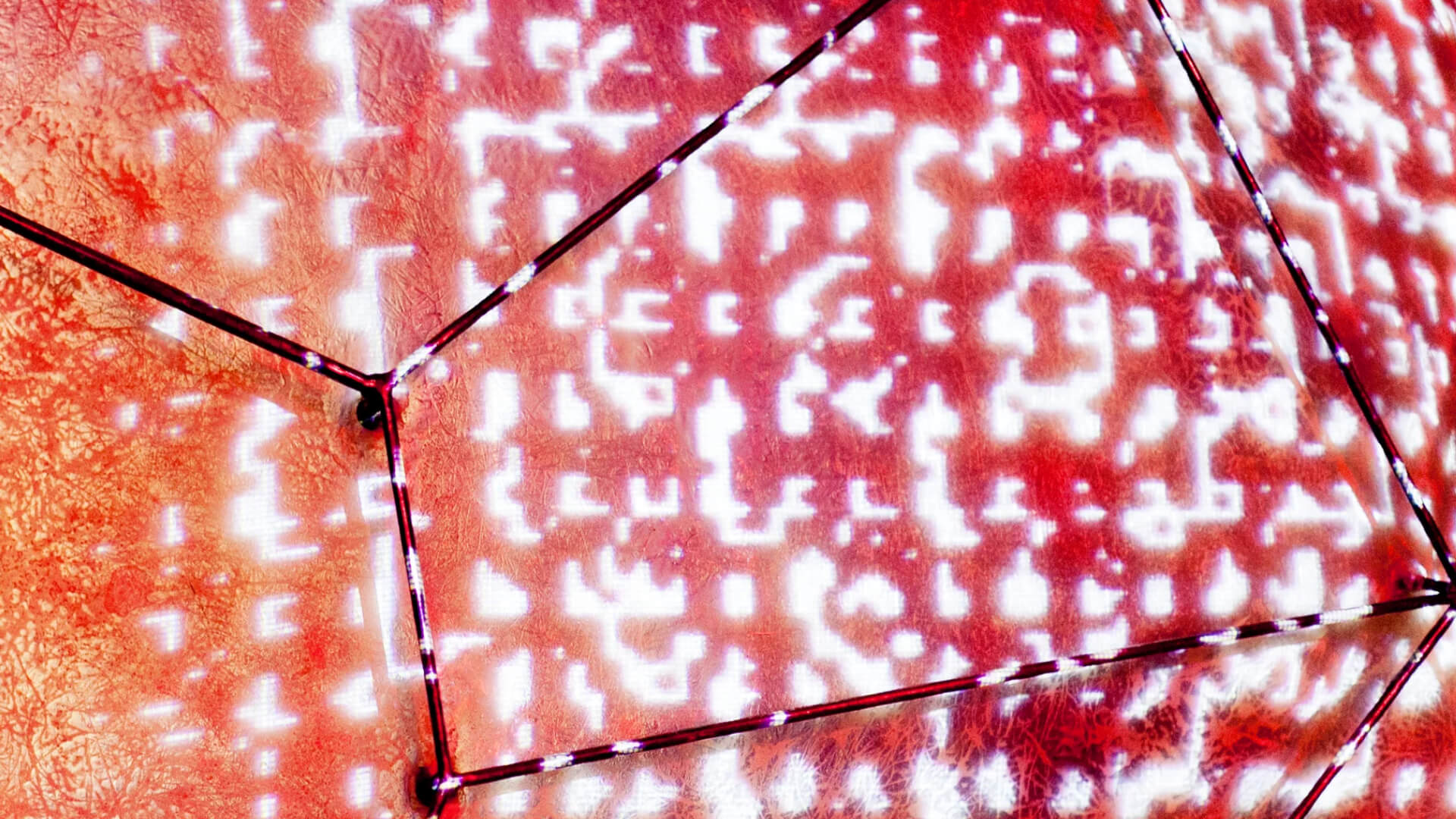
Within an intimate capsule, two participants encounter a responsive system that translates correlations in their brain activity into fields of sound and light, transforming invisible processes of attention, connection and shared presence into a collective sensory experience. As moments of synchronisation emerge, the environment becomes increasingly coherent and vivid; as synchrony dissolves, the audiovisual landscape drifts towards fragmentation and instability.
Concept
Developed by neuroscientist Suzanne Dikker and artist Matthias Oostrik, Mutual Wave Machine operates simultaneously as an immersive installation, participatory performance and platform for public neuroscience research. Participants sit face-to-face while EEG sensors measure correlations between their neural activity. Rather than presenting scientific data directly, the system transforms these relationships into a responsive audiovisual environment that can be experienced from within and observed from outside the structure.
Positioned between artwork, scientific experiment and social encounter, the project investigates how technological mediation can reveal, amplify or reshape interpersonal relationships. It asks whether attention, empathy and human connection can become perceptible through sound, light and interaction, transforming abstract neurological processes into direct embodied experience.
Presented internationally across museums, festivals, educational programmes and research contexts, Mutual Wave Machine evolved beyond a single installation into a broader art–science platform. Through thousands of participant encounters, the project contributed to ongoing investigations into interpersonal synchronisation, collective attention and social interaction outside traditional laboratory settings.
Pandelis Diamantides developed the interactive audio system, sound environment and real-time sonic behaviours of the installation. Operating as an active component of the neurofeedback loop, the six-channel audio system continuously responds to fluctuations in neural synchronisation, shaping participants’ perception of coherence, resonance, distance and disruption within the shared environment.
Credits
Concept & Cognitive Neuroscience
Suzanne Dikker
Concept, Visualisation & Software
Matthias Oostrik
Interactive Audio System Design & Development - Sound Design
Pandelis Diamantides
Visualisation & Artistic Consultation
Peter Burr
Object Design
Spectro Productions
Technical Specifications
Year
2013–present
Materials
Steel, polyester
Media
2-channel EEG
2-channel video
6-channel interactive audio
Duration
8 minutes
Dimensions
2.2 × 2 × 2.6 m
Footprint
7 × 12 × 4 m
Software
OpenFrameworks, Max/MSP, C++
Selected Exhibitions
AS ONE — NEON & Marina Abramović Institute, Benaki Museum, Athens
Pioneer Works, New York
Museum of Contemporary Art, Lisbon
Espacio Fundación Telefónica, Madrid
3LD Art & Technology Center, New York
FORMS Festival, Toronto
OPUS 1 Festival, Merriweather
Innovation Expo, Amsterdam
Lowlands Science, Lowlands Festival
Lexus Hybrid Art, Moscow
NEMO Science Museum, Amsterdam
Silicon Valley Contemporary, San Jose
EYE Film Institute, Amsterdam
TodaysArt Festival, The Hague
Research Impact
Mutual Wave Machine formed part of a broader programme of interdisciplinary research exploring interpersonal synchronisation, social interaction and collective behaviour through real-world neural measurements. Through public participation in museums, festivals and educational environments, the project generated one of the largest datasets of brain activity recorded during natural social interaction, contributing to influential research on brain-to-brain synchrony, attention and collective experience.
The project has been featured internationally across artistic, scientific and educational contexts and stands as a significant example of how immersive artistic environments can function simultaneously as spaces for participation, experimentation and knowledge production.
Mutual Wave Machine (2013–present)
Interactive Neurofeedback Installation
with Matthias Oostrik & Suzanne Dikker
Mutual Wave Machine explores what it means to be “on the same wavelength” with another person. Emerging from research initiated through Marina Abramović’s Mutual Gaze and developed at the intersection of art, neuroscience and participatory experience, the project transforms neural synchronisation into an evolving audiovisual environment.
Within an intimate capsule, two participants encounter a responsive system that translates correlations in their brain activity into fields of sound and light, transforming invisible processes of attention, connection and shared presence into a collective sensory experience. As moments of synchronisation emerge, the environment becomes increasingly coherent and vivid; as synchrony dissolves, the audiovisual landscape drifts towards fragmentation and instability.
Concept
Developed by neuroscientist Suzanne Dikker and artist Matthias Oostrik, Mutual Wave Machine operates simultaneously as an immersive installation, participatory performance and platform for public neuroscience research. Participants sit face-to-face while EEG sensors measure correlations between their neural activity. Rather than presenting scientific data directly, the system transforms these relationships into a responsive audiovisual environment that can be experienced from within and observed from outside the structure.
Positioned between artwork, scientific experiment and social encounter, the project investigates how technological mediation can reveal, amplify or reshape interpersonal relationships. It asks whether attention, empathy and human connection can become perceptible through sound, light and interaction, transforming abstract neurological processes into direct embodied experience.
Presented internationally across museums, festivals, educational programmes and research contexts, Mutual Wave Machine evolved beyond a single installation into a broader art–science platform. Through thousands of participant encounters, the project contributed to ongoing investigations into interpersonal synchronisation, collective attention and social interaction outside traditional laboratory settings.
Pandelis Diamantides developed the interactive audio system, sound environment and real-time sonic behaviours of the installation. Operating as an active component of the neurofeedback loop, the six-channel audio system continuously responds to fluctuations in neural synchronisation, shaping participants’ perception of coherence, resonance, distance and disruption within the shared environment.
Credits
Concept & Cognitive Neuroscience
Suzanne Dikker
Concept, Visualisation & Software
Matthias Oostrik
Interactive Audio System Design & Development - Sound Design
Pandelis Diamantides
Visualisation & Artistic Consultation
Peter Burr
Object Design
Spectro Productions
Technical Specifications
Year
2013–present
Materials
Steel, polyester
Media
2-channel EEG
2-channel video
6-channel interactive audio
Duration
8 minutes
Dimensions
2.2 × 2 × 2.6 m
Footprint
7 × 12 × 4 m
Software
OpenFrameworks, Max/MSP, C++
Selected Exhibitions
AS ONE — NEON & Marina Abramović Institute, Benaki Museum, Athens
Pioneer Works, New York
Museum of Contemporary Art, Lisbon
Espacio Fundación Telefónica, Madrid
3LD Art & Technology Center, New York
FORMS Festival, Toronto
OPUS 1 Festival, Merriweather
Innovation Expo, Amsterdam
Lowlands Science, Lowlands Festival
Lexus Hybrid Art, Moscow
NEMO Science Museum, Amsterdam
Silicon Valley Contemporary, San Jose
EYE Film Institute, Amsterdam
TodaysArt Festival, The Hague
Research Impact
Mutual Wave Machine formed part of a broader programme of interdisciplinary research exploring interpersonal synchronisation, social interaction and collective behaviour through real-world neural measurements. Through public participation in museums, festivals and educational environments, the project generated one of the largest datasets of brain activity recorded during natural social interaction, contributing to influential research on brain-to-brain synchrony, attention and collective experience.
The project has been featured internationally across artistic, scientific and educational contexts and stands as a significant example of how immersive artistic environments can function simultaneously as spaces for participation, experimentation and knowledge production.